Earworm
New 10th anniversary edition of my acclaimed novel about what happens when AI and the music business collide.

March 2026
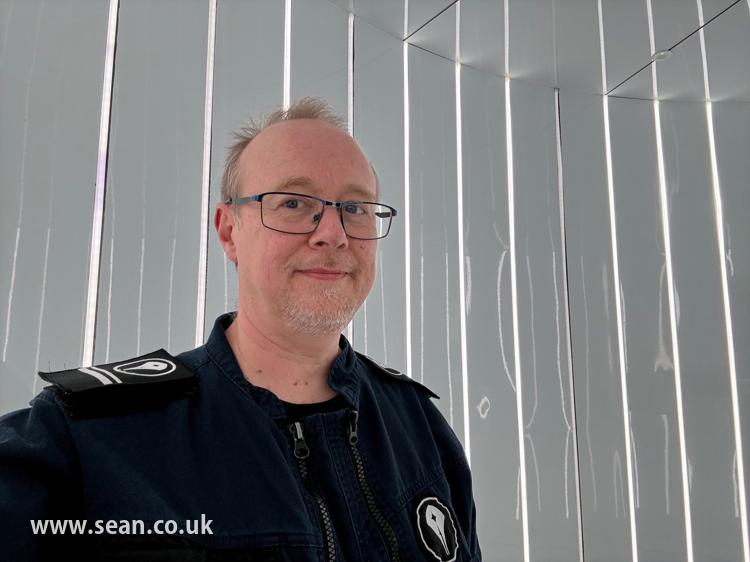 What makes great immersive theatre? At Bridge Command, it’s about making sure participants “feel like they played a good game, but also had a story told well,” said Owen Kingston, artistic director, Parabolic Theatre Company.
He was speaking at a one-day workshop on immersive and interactive performance that took place on the spaceships.
I’d experienced Bridge Command before, which is one reason I was keen to attend the workshop. Last summer I beamed aboard the Warspite with 13 friends ready for adventure. We undocked the UCS Takanami, took on roles such as captain, engineer and weapons officer, and set off on an exploration mission. It involved an encounter with space pirates and a daring rescue.
I captained a small shuttle craft attached to the Takanami. Watching our mothership drift away on the radar screen, I felt strangely distant from the rest of the crew. When we docked with a stranded ship, I was so immersed in the world that I was surprised when our airlock opened and someone we didn’t know stepped in.
The attention to detail in Bridge Command was excellent and shone through in the acting, the spacecraft, and the whole story.
And it was story that was at the heart of Owen’s presentation opening the workshop.
Immersive theatre can mean many things, and Owen started by describing several types of interactivity he’d seen. These ranged from the illusion of interactivity (the audience is asked for input but the same thing happens anyway), through chaotic interactivity (where game mechanics control the outcome), limited interactivity (where things are done to you, but your response is irrelevant), and decision trees where the story is pre-ordained and you can choose different paths through it.
I’d experienced several of those before. An entertaining Alice in Wonderland production a few years ago had multiple paths through scenes that were otherwise always the same, and Fame Factory in London’s Docklands enables you to interact with the cast, but without any impact on the story.
When the ideas and creativity of the participant are rejected, the participant no longer feels like they’re part of the world of the show, Owen said. In a decision tree show, you might be presented with three options. When you propose a new option D, you expect agency in a live show and expect it to pivot.
“The best way to immerse someone in the world is to allow participants to affect the world of the show,” he said. “Staff [in other productions] don’t like it. It’s easier to fall back on predetermined options.”
“The biggest part is trust in empowering performers,” said Owen. “You can’t make it work with teenagers on a summer break, like an escape room.”
He gave an example of one of Parabolic’s shows, King and Country, in which MPs are in a bunker deciding what to do as Britain is invaded during the second world war. The guiding principle is never to refuse a reasonable in-world request, so that the audience can make meaningful suggestions that profoundly affect the world. When someone asked to phone Hitler, that clearly wasn’t a reasonable request in the game world, so they were instead told that they could send a message through a back channel in Switzerland.
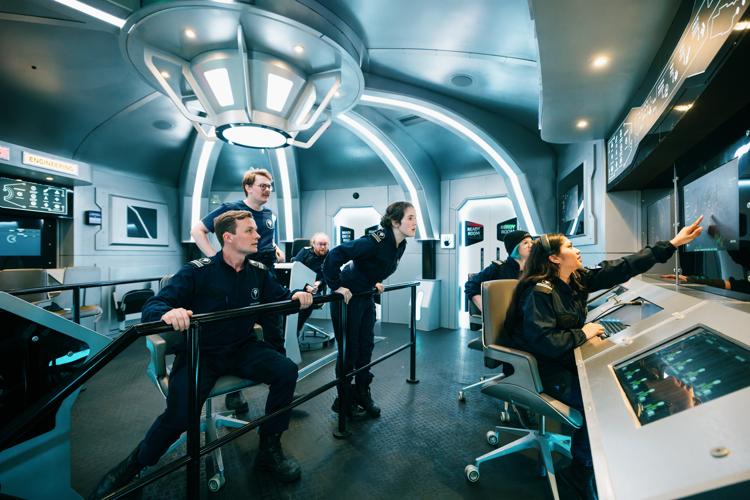
Members of the cast of Parabolic Theatre in Bridge Command. ©Alex Brenner. Used with permission.
However, when someone asked to talk to Rod Stewart during a 1970s show set in the corridors of power, that was considered a reasonable request. One of the actors behind the scenes was tasked with learning his voice by watching YouTube videos, while another played his agent, trying to schedule the call.
“Try to extend the world in the direction they push in,” said Owen.
Owen noted that all Parabolic’s shows have physical boundaries on where people can go. Having a logical border to the world makes it feel bigger. In Bridge Command, it would be easy to just have the bridge, but building the rest of the spaceship, the space station around it, and the transporter room creates a complete world.
Parabolic shows hit the same beats as a movie script so that there is a strong story, even though the audience has a lot of freedom within it. The story is more important than a fair game: don’t let chance or skill determine how good the story is, Owen said.
The beats for first-time players include:
Bridge Command is an ongoing soap opera, where each day follows the previous one and characters continue. If an audience member performs well in the show, they can achieve promotions which are noted for their return. There's a sense of community around the show with many returning participants. Once a month there is a sea shanty session in the officers' mess, which people can attend without going on a mission.
The four guiding principles for Parabolic Theatre are:
Christopher Styles, one of the cast at Bridge Command, led a workshop session on facilitating interactive theatre. He noted the role that facilitators have conveying the lore of the world and bringing clarity to the narrative. Unlike with live action role plays (LARPs), audience members will attend immersive theatre productions with no prior knowledge or prepared character.
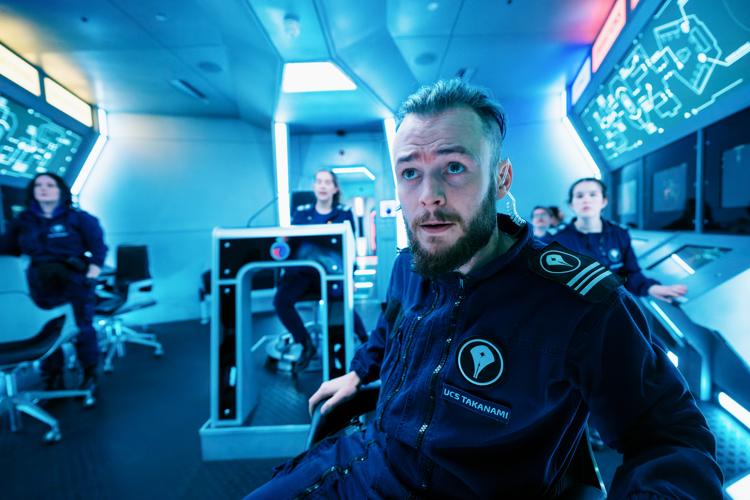
Christopher Styles (right centre) in the Helm Officer role in Bridge Command. ©Alex Brenner. Used with permission.
Christopher noted the importance of keeping the show on track, ensuring that the audience members understand the world, the task and their options, and that the show runs on time. “Understand the beats and balance of the show,” he said. He noted that five minutes spent making a plan followed by five minutes in battle is not as satisfying as two minutes planning and an eight-minute attack.
Bad decisions are not penalised, he said, and a bad decision is better than no decision and often more fun and dramatic.
The workshop also included practical sessions. We played Grandmother’s Footsteps and learned the importance of being aware of the audience but not playing up to them. We improvised a silent western, where the goal was to ensure that the ensemble was working together to deliver a performance that invited the audience in. We also created some short immersive experiences, including a whodunnit where the audience quizzes suspects and a hijacking where the audience must resolve the conflict.
One of the workshop participants asked Owen whether there were any plans to use artificial intelligence (AI) at Bridge Command. “We’re giving people what they didn’t realise they wanted,” he said, highlighting that originality is not a strength of AI. “We might use some AI to write software and create images, but not for writing stories. I’d rather pay a person to do it well.”
© Sean McManus. All rights reserved.
Visit www.sean.co.uk for free chapters from Sean's coding books (including Mission Python, Scratch Programming in Easy Steps and Coder Academy) and more!
New 10th anniversary edition of my acclaimed novel about what happens when AI and the music business collide.
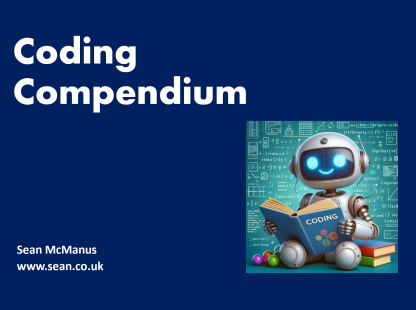
A free 100-page ebook collecting my projects and tutorials for Raspberry Pi, micro:bit, Scratch and Python.
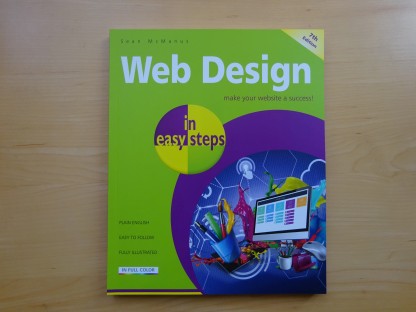
Web Design in Easy Steps, now in its 7th Edition, shows you how to make effective websites that work on any device.

Power up your Microsoft Excel skills with this powerful pocket-sized book of tips that will save you time and help you learn more from your spreadsheets.
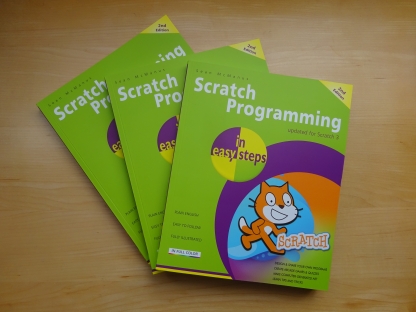
This book, now fully updated for Scratch 3, will take you from the basics of the Scratch language into the depths of its more advanced features. A great way to start programming.
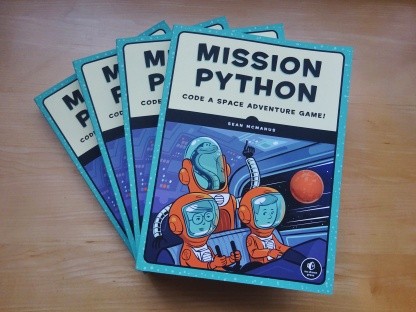
Code a space adventure game in this Python programming book published by No Starch Press.
 Top | Search | Help | Privacy | Access Keys | Contact me
Home |
Newsletter |
Blog |
Copywriting Services |
Books |
Free book chapters |
Articles |
Music |
Photos |
Games |
Shop |
About