


The Sun and Daily Mail hoaxed by ghostly iPhone app
05 March 2010
Here's a photo I took at Gloucester Cathedral last year:
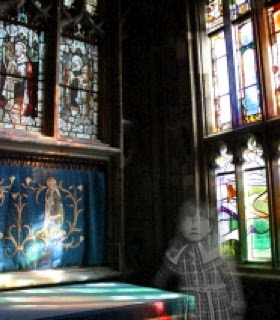
Or have I tampered with the picture?
The answer to that should be obvious, but both The Sun and the Daily Mail were hoodwinked by a similar picture. If you're quick you can read the full Daily Mail article here, and The Sun's story is here. The photo is credited to Hull News & Picture, which says it does "editorial digital photography".
The photographer John Fores is a builder, and took his photo at a school he was demolishing. He claimed that he took photos to record the demolition work, but that the apparent ghost of a boy in a flat cap in one image made "the hairs on the back of [his] neck stick up". He said: "I didn't believe in ghosts, but since I got this picture, I am not so sure."
Fores has clearly been deceptive here: The Mail says that he insists he has not edited the photo, which means they asked him and he denied it. The Sun's picture of him on the building site with his mobile phone shows him with a beaten up old camera phone, and not the iPhone he used to create the image. Derren Brown would be proud of such an artful misdirection.
But surely the press should use more common sense than that? Just because a member of the public says they have a picture of a ghost, that doesn't mean it's true. Even if the story were included as a bit of fluff, its tone could be different. The Sun opens with "A builder demolishing an old school discovered this eerie image of a young boy in a mobile phone picture taken of the site", which effectively endorses the builder's story. The Daily Mail said: "The ghostly image of a young boy was captured on camera as builders demolished an old school building. John Fores, 47, insists the spectral figure was not present when he took the picture..." To use the picture as some light entertainment and keep their credibility, the papers could have taken a more sceptical angle, or even softened their reporting by saying the photographer claims he took the photo normally, rather than just reporting that he did. (There's a guide to handling of uncorroborated statements in the context of press releases, here).
One reason this reflects badly on the newspapers is that many of their readers know exactly how the pictures were taken. Although a lot of people immediately suspected Photoshop had been used, it took just three hours for someone to comment on the Daily Mail that the shot was created using an iPhone app. That app is called Ghost Capture, which costs 59p and enables you to add ghosts to your pictures. It can also be used on the iPod Touch to edit photos loaded on the device. I used the free lite version to make the picture above.
At the time of writing, neither newspaper has corrected their story to make clear that it's fake, which sends a strong signal that they don't care about accuracy or truth. Next time you read a story in those papers, ask yourself whether you are being lied to.
Labels: apps, humour, iPhone, iPod, journalism, photography

Should writers study for an MA?
21 January 2010
Andrew Motion has come out in support of creating writing courses, according to a story in The Times. He said: "People who had no qualms about RADA, or the Royal Ballet School, or the Royal Academy, were wont to say that writing couldn't be taught ... and implied that this sort of tutoring was a form of cheating, like taking steroids if you were an athlete."
His quote is in the context of prize-winning authors. The Times expresses concern that publishers might go fishing for writers on creative writing courses instead of seeking out talent in the wider writing community.
On the one hand, perhaps it's reasonable to expect authors to make an investment in their future and to take their profession seriously. If you want to talk to major publishers about your novel, you need to have a good answer for why they should talk to you. How do you stand out among the thousands of people trying to get their attention? Many of these are wasting their time, so how do you prove you're not? Having an MA shows a level of commitment to your craft that goes above and beyond what most people have invested.
There is a risk, though, that publishing becomes increasingly elitist. It can cost over £7,000 to study for an MA in creative writing, which effectively excludes that option for most writers. And while an MA might show that you've applied yourself to the study, it's no indication of the initial talent you're building on, or the consistency or originality of your ideas. The time required to study for an MA also excludes many people who could write (or indeed have written) a novel.
While an MA will certainly be of intellectual and creative value, does it make good business sense? The Bookseller reported last year that mid-list authors are having their advances cut. Are publishers offering higher advances to authors with an MA? That seems unlikely. It might take two or more novels before the investment in the MA is repaid, unless the first book turns out to be a massive hit.
Labels: journalism, training, writing
How much will people pay for journalism work experience?
17 December 2009
The Evening Standard carried out an auction of unique experiences in aid of a children's charity, with the winning bids reported in yesterday's paper. What surprised me is how much people are willing to bid to have a taste of work as a writer, photographer or other media professional. Below are the media-related bids (in bold), together with a selection of other bids to give you an idea of how they compare.
- £14,600 - Dinner for 12 cooked by Gordon Ramsay (highest bid for any lot)
- £14,000 - A day with Richard Branson
- £8,100 - Two tickets for the 2010 final of Strictly Come Dancing
- £7,153 - A week on the Evening Standard's "fast-paced, hectic" newsdesk
- £5,600 - Tea with Elton John
- £5,450 - A two-week internship at Island Records, mentored by Duncan Beese who signed Amy Winehouse
- £5,300 - Dinner with the Evening Standard's editor at his favourite Notting Hill restaurant
- £3,958 - A two-hour art class with Tracey Emin
- £3,600 - Dance lesson with Anton du Beke
- £3,115 - Afternoon tea with TV and radio presenter Claudia Winkleman
- £3,100 - Artworks by Gilbert and George
- £2,801 - Take part in a Vogue fashion photo shoot (not clear whether this is as a model or helping to shoot it)
- £2,550 - A week's work experience on ES magazine
- £2,550 - Mentoring with James Caan from Dragon's Den
- £2,070 - Join BBC Five Live in the media centre at Lord's for the Test against Bangladesh
- £1,982 - Caroline Michel, boss of literary agency PFD, will critique your manuscript and give you guidance on publishing
- £1,470 - Two guests have "unprecedented access" to the Match of the Day studio
- £1,200 - A springtime stroll around the park with Bob Geldof
- £1,100 - Four people chauffeured to work by Rowan Atkinson in a Rolls Royce
Is it becoming that difficult to break into media that people are willing to pay £1,430 per day to work on the Evening Standard's news desk? Is it so hard to get the attention of an agent that somebody would rather pay £1,982 than go the long way around? Will work experience in the media deliver a better return on investment than artworks by Gilbert & George?
Of course, people don't really think like that. If they want something, they bid what they can afford to try to win it. They don't compare the lots. But I'm surprised that mentoring from James Caan (which I can see really helping a lot of businesses to reinvent themselves) is considered less valuable than a week's work experience on the ES Magazine. I'm surprised that dinner with a newspaper editor is more highly prized than time with Bob Geldof, Sebastian Coe, Jonathan Ross, Sophie Dahl, the Duchess of York, Stephen Fry and the QI team, footballer Harry Redknapp, director Guy Ritchie, Graham Norton and artist Anish Kapoor (who all featured in lower ranking bids).
Labels: business, journalism, publishing, writing
Greatest story of my life ever!
20 November 2009
From time to time, I get emails from people who tell me they have the greatest story ever that they need help breaking. Sometimes it's a crime story, and other times it's a big political story. Occasionally, it's a campaigning-style story.
I know what you're thinking because I think it too: why me? My journalism experience hasn't yet stirred national newspapers, and my specialist subjects to date have been technology, business and music.
I never know how to respond to these people. Some of them are genuine people, trying to help others out, and struggling to draw attention to something the world should know about. Some of them are just trying to help themselves out, and use the press as a weapon against their opponents. Some of them might actually be insane.
For those who have uncovered a genuine injustice, I usually feel there are others far better placed to break the story. There are people who understand their way around parliament, who have friendly lawyers to advise them, and who know how to get stories of that type into print. I would face a steep learning curve. I do sympathise with many of these stories, but I don't have the time, experience or energy to help. Although I might admire those who are campaigning for justice, I can't give more than a one-time friendly email offering support.
Those who are using the press as a weapon against their opponents often appear to have a valid case, or at least a right to be heard. Sometimes they're being oppressed. After all, the most powerful people have easy access to the media, and it's the less powerful people who can struggle to get heard. But again I don't have the right experience to make these stories fly. Nor do I have the time to really vet the stories so that I can blog about them with confidence in their accuracy. I don't believe that journalists must be impartial, but I do believe that they must base their opinions on facts, which means a lot of independent research.
For the people who show signs of paranoia and instability, I've tried to bow out gracefully and wish them the best with their story. They inevitably won't stop emailing.
I've never broken a national news story before, but if I were planning to, this is what I'd do:
- Try to identify a named journalist with a professional interest in my story. That might be somebody working on a national newspaper, local newspaper, trade magazine, or website with a significant relevant audience. Ideally somebody with a history of breaking stories, but that would probably be quite hard to find. Private Eye is a fine news publication, and if the story were relevant for one of their columnists, they'd be near the top of my list. I wouldn't automatically go to the Sunday Times or email everybody that Google says is a journalist.
- If it is possible to get proof using my skills, I'd make sure I do that before approaching anyone. I often receive emails that say I'd need to do a lot of work digging up proof, which means I'm being offered a rumour to investigate, and some of the rumours are too outlandish to justify investigation without more to go on.
- Prepare my pitch: a short description of the story, how it can be proven to be true, how I came across it, and who I am in relation to the story. Ideally, my pitch would be something like 'I have proof that [this person] has [done this]'. My own credibility is important here too.
- Telephone the journalist. Check first whether they're on deadline, if not, start to tell them about the story. Let them lead the conversation. They will know the right questions to ask to work out whether the story has legs for them or not. I think the stuff I've prepared for my pitch will answer their top four questions.
- Send them what they need, or arrange to meet if that's what they need.
- If I couldn't break the story using the conventional press, I'd research it and write it myself and put it on the internet. I'd then run a PR campaign online to draw attention to the story from other websites, attract links and embed the story in social networks (Facebook etc). I'd see if once the story had been broken, I could get the press to pick up on that: eg '[name] has published evidence that proves that...'
- If I wanted to try to make money from the story, I'd research it thoroughly, write it up, and then pitch it as a freelance contribution to relevant publications. Alternatively, I'd try to sell it as a tip-off. The difficulty with both approaches is that tabloids in particular have a track record of not paying up, and sometimes it's hard to negotiate the value of the story without giving it away. If the story warrants it, I'd consider writing a book and trying to get the book published, including serialisation in the press. I have assumed, though, that most people emailing me aren't looking to make money from their stories.
(To clarify: I am still happy to receive emails from people who are approaching me because they know their idea is relevant to my interests, perhaps based on what they've read on this website. Personally addressed emails get more attention, and emails that explain why I'm being approached will almost always get a personal reply).
Labels: journalism, writing
Does Google help avert dementia? Or did the papers make that up?
24 October 2009
I was interested to see a story in The Telegraph (and other newspapers) last week claiming that using Google can help to delay dementia. It's based on research from UCLA, presented at the 2009 meeting of the Society for Neuroscience, and announced in a press release. I thought this might be a nice piece of trivia to include in my next book Social Networking for the Older and Wiser.
When I studied the press release, though, I was surprised to see that there was no mention of dementia. I asked UCLA whether the dementia angle is something that has come through UCLA interviews, is in the full research report, or is something that the media have added to spin the story. UCLA kindly replied with a copy of the poster (which is what was presented at the event), the abstract and press release. The researchers confirmed that the information presented at the meeting followed the content of those, which make no mention of dementia.
The research is fascinating, and did find first-time internet users experienced more brain activity in the areas associated with working memory and decision making. "The results suggest that searching online may be a simple form of brain exercise that might be employed to enhance cognition in older adults," said Teena D. Moody, the study's first author and a senior research associate at the Semel Institute at UCLA. But there's no speculation regarding dementia in the released materials.
There's a gap here between what the study appeared to discover, and what the headlines screamed (at about 20 publications, including the Daily Mail). I'm no scientist, but if the dementia angle were true, I would have expected to see it in the press release. Apart from how much easier it would make it to promote the research, tapping into a major health concern helps research bodies to attract funding.
If the source isn't UCLA, how did so many outlets get the same angle? It's possible they pulled it from the same syndicated content which is how several newspapers came to quote a fake David Milliband Twitter feed when Michael Jackson died. It's also possible that they're watching each others' websites all day, and one over-eager sub bigged up the story, and all the others followed suit. Maybe they have an alternative source (including other scientific publications), although it's odd they haven't mentioned it. I can't trace a credible source using the dementia angle.
What bothers me most, though, is this: I consume hundreds of news stories a week. When I take the time to actually dig into one of them (I've probably spent about an hour on this), it proves extremely difficult to back it up. None of us has time to check a tiny fraction of the stories out there.
Labels: journalism, social networking, technology
Publish and be Damned Fair
09 August 2009
There's a self-publishing fair planned for 27 September in East London, organised by Publish and be Damned. If you're a self-publisher, you can apply for a place at the fair now to promote and sell your publications. If you're a reader, why not put the date in your diary and plan to go along? You'll find a thriving independent press which you might otherwise not come across, and will doubtless find lots of new ideas.
Labels: books, journalism, publishing, writing
Reuters publishes style guide
23 July 2009
Reuters has made its journalism handbook available for free download and reading online, for the first time. It provides an interesting overview of how Reuters sees the role of the journalist, and includes a comprehensive guide to Reuters style.
The style guide is vital for creating a consistent style and voice across the output of Reuters' whole workforce. Consistency is important to avoid distracting the reader, and style guides highlight many of the areas where discrepancies can occur which you probably hadn't thought of before.
The guide also highlights mistakes that writers often make, but shouldn't. There's guidance there on the difference between 'advice' and 'advise', and there's an entry on 'advance planning'. You should be able to guess their views on that, but it wouldn't be in the guide if nobody ever wrote it.
I'm a bit of a style guide collector. Every editor has his own pet peeves, and it's fun to spot the stuff that's only there because it drives the editor up the wall. If you haven't written to a style guide before, adopting one will make you a better writer. It will prompt you to think about the words you use, and the ideas they convey, and it will help make your writing invisible so your message can shine through.
Other online style guides include The Guardian style guide and The Times Style Guide. Please let me know if you're aware of any others.
Labels: journalism, writing
Michael Jackson, David Miliband and me
27 June 2009
Most people who are into pop music have a Michael Jackson memory. Michael Jackson's "Bad" was one of the first tapes I had, and one of the albums I came back to when writing UoD. Back in 1987, I remember listening to the singles from it on the Radio 1 roadshow, while I was writing Amstrad games in the school holidays. I also remember myself and my brother being allowed to watch the then-new video for "Thriller" when a friend of my parents brought it around on a VHS.
I didn't expect Jackson to do his 50 gigs at the O2, but I didn't expect him to die either, so it's a bit of a shock to hear he's gone. In the same way that my parents' generation remember where they were when Kennedy and Lennon died, many in my generation will remember where they were when they heard that Jackson had died.
For the music industry, the passing of Michael Jackson must have been a day of mixed emotions. As a performer, he was electric. His dancing was so distinctive that many videos showed him in silhouette. Who else can get away with that? "Thriller" is the best selling album of all time (and probably always will be), and Jackson is one of a handful of performers who are cultural icons.
On the other hand, I'm willing to bet the Jackson records are on display prominently in every record shop this weekend. For a music business that's struggling to adapt to the new online economy, the sales boost that comes with a major star's death will be seen as welcome by some. Yesterday, Jackson had the top seven bestselling albums on iTunes, and held about 10-20% of the top 100 song downloads.
It's always struck me as odd the way record sales peak after a star's death. The fans already have the records, so these sales are driven by people who just never got around to buying the albums for the last twenty years or so, and then suddenly decide they quite liked some of them when the star dies.
Social networks played a big part in spreading the news of Jackson's death, and people's reactions to it. When Princess Diana died, online social networks weren't around as we know them today. Because most of my friends shared their views on Jackson's death, through status updates in Facebook and tweets on Twitter, it felt like a shared experience. As Jackson sang, "You are not alone".
Both The Times and The Telegraph leaped upon the Twitter feed of UK foreign secretary David Miliband, in which he said: "Never has one soared so high and yet dived so low. RIP Michael." Only, it wasn't the real foreign secretary. It can be difficult to validate celebrity Twitter feeds (Valebrity attempts to fill that gap, and Twitter has started to validate some accounts itself). But a little common sense goes a long way. Some of the tweets from the fake Miliband include:
Another idea from Eyebrows, sack all the drivers and use McDonalds staff instead. He reckons Reagan would have done it. No Al!Many of the other tweets are gently satirical, but there are enough clues there for a journalist to work out they're looking at a fake. Even with the complexity of identity today, and the way that many people will have a professional and informal persona in different places, journalists are supposed to be skilled at fact checking. It's one of the ways they can add value in a world where information is increasingly free. If they can't filter the fakers from our own government ministers, how can we trust anything else they write?
Labels: business, journalism, music, social networking, university of death
History of the internet updated
05 June 2009
I've updated my timeline of the history of the internet. It was originally written in 2004 and hadn't been updated since then, so I've now added in the major developments of the last five years. Incredible to think that social media sites like YouTube, Flickr, Twitter and Facebook are all less than five years old.
Labels: business, journalism, technology
How to train to be a journalist
15 December 2008
Over the years, I've received quite a few queries from website visitors asking me about whether a journalism course they're considering is any good or not. I've usually declined to comment because it's not fair to judge courses I haven't been on, but I've now uploaded some guidelines to help people pick the right educational path for their journalism career.
The article answers the following questions from readers:
- I'm 14 years old and I'm picking my exam subjects. What will be useful in my chosen career as a journalist? Should I pick history or geography?
- Should I take a course in journalism?
- Should I study for a degree in journalism?
- I'm thinking about quitting my degree studies to work as a journalist now. Is this a good idea?
- What about correspondence courses in journalism?
- Can you tell me if this [named] course is any good please?
- What else do I need to do while I'm training?
Labels: journalism, writing
Writing tip of the day
21 October 2008
Shorter sentences rock.
Labels: journalism, writing
Amazon Kindle: an opportunity for self-publishers?
15 April 2008
I blogged about Amazon's Kindle, a new ebook reader, when it launched. But I didn't look at the opportunity for self-publishers then.
I've published a few ebooks in the past. My ebook 'Journalism Careers - Your questions answered' is sold as a PDF file designed for comfortable on-screen reading. I previously published a guide to putting sound in webpages and a Javascript tutorial through Fatbrain, which was an online ebook store. That folded years ago, and it looks like Barnes & Noble has bought the domain name.
So what's the opportunity at Kindle? Not much for me, it seems. You need to have a US postal address and US bank account details before they will let you publish any content. You can't even publish content for free and use Kindle as a promotional outlet (ebooks must be priced between $0.99 and $200, and you still need to be in the US). Given how slow Amazon's been in internationalising other features like Amazon Honor System, none of that is likely to change any time soon.
My friend John went through the motions of setting up a publication anyway, and has blogged about that experience.
There are a couple of terms that might worry some self-publishers. Firstly:
3. Digital Books; Marketing and Promotion. You agree that we may market and promote your Digital Books by making chapters or portions of your Titles available to prospective customers without charge, and permitting prospective customers to see excerpts of the Digital Book in response to search queries. Amazon will not owe you any fees for the marketing and promotional efforts described above. The Program may include features that allow users to print one or more pages of your Titles.The short version of that is: Amazon can distribute content from the book and allow users to print it, without charging for it and without paying you for it.
The 'permission to print' seems to go beyond the deal Amazon's already struck for 'Search inside this book' for promoting printed books on its website. It's essential for authors to give away some preview content to demonstrate the value of their books. Indeed, similar terms are usually a part of a conventional publishing contract. But Amazon's a shop, not a publisher. Authors and publishers should decide what material is promotional, and what material is only available for sale. Amazon wants the right to give away whatever content it wants, albeit with the implied motive that it will try to pick content that will help the book sell.
For reference works, the value could be significantly eroded if Amazon allows excerpts to be printed without any payment. We can only hope that Amazon is working on a way of administering micropayments so that people can buy book excerpts and authors can be rewarded appropriately.
Also, Amazon will keep 65% of the retail price. By comparison, Lulu charges a fee of 25% of what you get (which is then added to the sale price, so it's actually less than 25% of the ebook price). If you're a self-publisher, 35% is probably not too bad a return given that there's no work to do with moving printed books and there's no cost to incur in creating them, but it's far from competitive. It also seems to overstate the costs incurred in operating the infrastructure and underestimate the costs involved in creating content.
10. Technology. You acknowledge that we will be entitled to utilize DRM technology in connection with the distribution of Digital Books but are not obligated to do so. Accordingly, there may be no technology or other limitation imposed by us on copying or transfer of any Digital Book we distribute.Personally, I don't approve of digital rights management technology. But when publishers are selling ebooks, they'll want to know what rights they're licensing and what controls will be used to enforce them and this term seems somewhat vague. There 'might or might not be DRM' isn't really a good basis for making a decision about whether you want to sell through Amazon, particularly if piracy or consumer rights is something you feel strongly about.
The use of the words 'irrevocable licence' set off alarm bells, but it seems this is about protecting consumers and ensuring that they will be able to download content they've bought easily in future. The irrevocable licence does not extend to making the ebook available for sale (so you can withdraw it later).
If anyone's actually self-publishing through Amazon Kindle, I'd be interested in hearing about your results in the comments.
Labels: journalism, marketing, publishing, technology, writing
How the music press works
06 July 2007
According to the NME, Fergie from the Black Eyed Peas has denied reports that she will mention Candie's clothes in song lyrics as part of a sponsorship deal.
The NME says: "It had been suggested she had signed a deal with clothing brand Candie's that would involve her including the fashion line in the lyrics of her songs."
Where had that been suggested? Well, this curiously blank page, for a start, which on Monday 2 July had the headline 'Fergie signs product placement deal' and the RSS subheading 'Black Eyed Peas star Fergie has signed a new deal to promote products in her songs'. It said: "The deal is a first in pop music - rather than namechecking the Top Shop-like brand, Fergie's contract states that she will write songs from scratch that specifically promote Candie's."
And the publisher of that page? The NME.
Is that what qualifies as a correction? Zapping the error-prone post out of history and then publishing a post that talks about 'media reports being wrong', without saying where they started? And to think, I was going to use NME as a credible source for a story I'm writing.
Labels: journalism, music
Prince and the price of music
29 June 2007
 Desperate times make for strange allies, which is why Prince is partnering with the Mail on Sunday. His new album 'Planet Earth' will be given away free as a covermount with the conservative tabloid on 15 July 2007, before the album has even been released in the shops. I can imagine the two million readers spluttering tea all over their croissants as they catch snippets of Prince's bad-boy lyrics. The paper has reportedly stumped up half a million pounds for the rights to the album and is encouraging Prince fans to pre-order the paper. The deal has royally teed-off distributor BMG, which has pulled out of its deal to distribute the album to UK shops as a result.
Prince has also made his new single 'Guitar' available as a free download [link no longer available] in a promotion with O2 for a limited period. And that's free as in 'no money' and free as in 'no controls' too - it's an MP3 with no restrictions on how you can use it. O2 took out a quarter page full colour advert in Metro to advertise the promotion.
For Prince, these are smart deals. It's a long time since he had anyone putting any serious money into promoting his work. The last couple of albums had great distribution, but that just made it easy for existing fans to buy it. They didn't reach out to many new listeners, even though they marked something of a return to form following a few years of patchy output (albeit touched by genius, at times).
Prince could just upload his music to the web and give it away, but then who's going to pay for the cost of producing an album and sustaining the artist during its creation?
With this deal, Prince can afford to give his album away to as many people as possible. To give an idea of scale, this deal will put at least 2 million copies of his album on the street on day one. His greatest creative achievement 'Lovesexy' has only sold 4.82 million in nearly 20 years, according to Wikipedia. (His bestselling album 'Purple Rain' shifted 22.8m units, according to the same source).
Does this devalue the music? Undoubtedly. Most free CDs end up in landfill unplayed, I suspect. It's hard to argue that people shouldn't copy music if you're giving it away with the telly pages. Since there's no distribution deal in the UK for the album at the moment, these free CDs will probably trade briskly on Ebay for a penny plus postage.
Does this deal devalue journalism? Yes, it probably does, also. The Mail on Sunday, in common with most newspapers, seems confused about what business it's in. Clearly, publications are in the business of distributing advertising and this could be seen as advertising. But increasingly, newspapers foist unwanted films and CDs onto listeners who have no choice but to bin them. With this move, the Mail on Sunday is basically conceding that it doesn't matter what their writers produce; what sells papers is a good covermount. While this deal might introduce some Daily Mail readers to Prince's music, it seems unlikely many who buy the paper for the CD will become regular subscribers.
But these are desperate times. At work, we're mourning the loss of our local Fopp, after the chain announced it was closing. It's becoming hard for record shops to survive. They can't compete with the range and pricing of Amazon, and the bargain basement of second hand back catalogue CDs on Ebay. I bought many albums in Fopp, including several that I heard for the first time in the store and wouldn't otherwise have considered buying. Without record shops, brand is likely to become even more important when it comes to shifting units online because you can only sell what people already want. People don't browse just to see what's there in the way they do in a store, and you can't force shoppers to listen to the lastest releases online.
Prince has shown he can build his brand in today's ailing music industry. He's taken a first step towards changing the economics of his business, earning money through concerts and giving away music to build demand for tickets. But he might just have burned some bridges along the way. It remains to be seen whether the record industry or Prince has the more sustainable model in the long run.
Labels: journalism, music, music promotion
Slow news day?
22 June 2007
So in my BBC RSS feed this morning, sat between 'Stagecoach wins railway franchise' and 'Bomb strikes UK patrol in Basra', is the headline 'Shot kitten's leg was amputated'. The subheading reads: 'A kitten is recovering after its leg was amputated after being shot with a pellet gun in County Antrim.'
This heart-rending story is so important, it is also in the third place on the Northern Ireland news homepage at the time of writing, with a photo.
It is a distressing story, but what's going to keep me awake at night is that the reporter didn't find out the name of the cat.
Labels: journalism, writing
Dip into the blog archive
June 2005 | July 2005 | August 2005 | September 2005 | October 2005 | November 2005 | December 2005 | January 2006 | February 2006 | March 2006 | April 2006 | May 2006 | June 2006 | July 2006 | August 2006 | September 2006 | October 2006 | November 2006 | December 2006 | January 2007 | February 2007 | March 2007 | April 2007 | May 2007 | June 2007 | July 2007 | August 2007 | September 2007 | October 2007 | November 2007 | December 2007 | January 2008 | February 2008 | March 2008 | April 2008 | May 2008 | June 2008 | July 2008 | August 2008 | September 2008 | October 2008 | November 2008 | December 2008 | January 2009 | February 2009 | March 2009 | April 2009 | May 2009 | June 2009 | July 2009 | August 2009 | September 2009 | October 2009 | November 2009 | December 2009 | January 2010 | February 2010 | March 2010 | Top of this page |