


Why can't I subscribe to The Beatles?
30 August 2009
There's much excitement in the music industry at the upcoming release of the remastered Beatles catalogue on CD. For people who own the earlier CD issues, there is some incentive to buy: there's a documentary on the first pressings, and the remastering has been carried out sensitively to enhance the sound without changing the music, according to Mojo magazine.
I can't help thinking they've missed a marketing trick here, though. At the moment, your choices are to buy the albums individually, or to buy a box set of them all for about £200.
What I'd really like to see is a subscription model. What if you could subscribe to The Beatles Remasters, and receive a new one in the post each month for a year? That works for the record label because it can effectively spread the cost of selling a high-ticket item, and so get more sales. It's also good for sales forecasting because the company knows how long the subscription will run for (14 albums). It would be an opportunity for EMI to build direct relationships with customers too, increasingly important at a time when record shops are going to the wall. For customers, it would be a great experience, particularly if accompanied by additional bonuses, such as notes on the Beatles timeline around that release, or period reviews - both cheap to produce.
Retailers could have stepped into this space too, but as far as I (and Google) know, nobody is doing this.
I wonder whether the record industry considered this and discounted it, or whether they it became locked into the old ways of selling music. That hasn't done them many favours in the recent past.
(Don't mind this: swp54kqdah)
Labels: business, marketing, music, music promotion

Chris Anderson's "Free" Audiobook and Ebook
09 July 2009
Chris Anderson's new book is called "Free", and is all about the history and future of giving things away in business. Contrary to some reports, it doesn't argue that everything should be free - it just looks at how giving some things away can enable you to sell some other things.
Some people have argued that authors should give away their work for free. The idea is that the reputation that builds as a result of that opens doors for consulting work, lecturing, media appearances and so on. Personally I'm not convinced by that argument: it means you have to work twice to get paid once, and it also means that your job changes from writer to consultant/lecturer/talking head, which is probably not what you really want to be. The writing just becomes marketing, rather than the focus of your creative and working life.
I can see how making things free can help to attract an audience, though, if you can afford to do so. At a time when it's hard enough to fight for people's attention, fighting for their money too is an uphill struggle.
Anderson's book is available in a couple of free formats. You can download the unabridged audiobook for free at Wired's website. The abridged audiobook will cost $7.50 from outlets including Audible. The thinking is that busy people might be prepared to pay more to save time. It's counterintuitive to charge more for less, but I do listen to a lot of audiobooks but can't ever remember getting through an unabridged one. The audio format just isn't as convenient as a real book for full-length works.
The ebook is available at Scribd, and embedded below, but you can't download or print the PDF. For more comfortable viewing, click the button in the top right of the box to view full screen. So much of the content on Scribd is there without the author's permission, so this promotion will also bring a lot of credibility to the Scribd platform.
The audio formats will remain free forever, but the ebook formats will be available for just one month. If all else fails you could always stump up for the hardback
 .
.UPDATE: The Scribd version of Free has now been withdrawn, after five weeks and 170,000 reads.
Labels: books, business, marketing, publishing, writing
London Book Fair review
30 April 2009
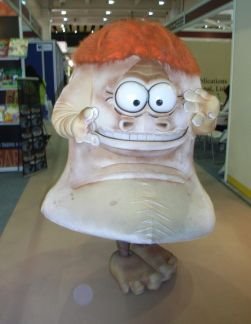 Last week was the London Book Fair, attended by publishers, authors and Flanimals (pictured, right).
It was interesting to see how digital books were received at the fair. There was an area at the back of the hall given over to ebooks and digital publishing, and the seminars there were packed out. But it seemed to be led by the technology, rather than the content. There were plenty of firms who could help you to repurpose and distribute your content for mobile platforms (including the iPhone and Sony Reader), but I didn't notice anybody promoting digital content.
I didn't see any discussion about how ebooks can be different to print books. A certain amount of this is built into the device (eg searchability), but there is lots of potential to create new types of content based on the written word. Mindsportlive is developing iPhone apps based on its card packs, including '52 Ways to Beat Stress', but it was very much the exception.
It's partly the nature of shows like this that means major publishers would sideline their digital offerings. If you're negotiating rights, a printed book looks more impressive. Experienced publishers can get a measure of the content quickly. With ebooks, you can't tell how big they are, how well proofread they are in the middle, whether the book's consistently structured and so on without flicking through a lot of virtual pages. There's not a 'flick through until something catches my eye' button on any of the devices I've seen. Also, since the ebooks are often sold directly, they probably don't belong at a show that's partly about negotiating print book distribution and sales with intermediaries.
One company from Russia has an interesting proposition for interactive physical products - it markets hardback comic books for adults, with an enclosed music CD and CD-Rom. On the CD-Rom is a Flash animation that brings the comic book to life, and the CD contains atmospheric music that goes with the story. The project has been led by the music, with the creator being a musician first and commissioning illustration to expand on his work, which is an interesting way to create value at a time when it's increasingly difficult to sell music. For more information, check out the Ylotana website.
The Espresso Book Machine for printing on demand attracted a lot of attention. The Blackwell bookshop in Charing Cross Road will now be able to print books on demand using the machine, which was demonstrated at the fair. The device is a great way to increase effective footage in an expensive store, and it means many books need never go out of print. But it also transforms the bookseller into a book distributor. Surely the point of a bookshop is that you can browse and discover new titles you wouldn't have otherwise read? Isn't the idea that the bookshop can sell you books you didn't already know about? Print on demand is likely to require the shopper to ask for a specific book to be printed, although it is theoretically possible for displays to be mounted to showcase print-on-demand books, enabling infinite sales based on one shelf copy.
Other news from the show: Simon Pegg's writing a book for publication in October (hurrah!). It's an autobiography/memoir (err... okay). Enid Blyton is coming back from the dead with six new stories being ghostwritten in her (presumably trademarked) name. She wrote over 700 stories when she was alive, so you wouldn't think there would be a need for this. I wonder whether we'll see the day when John LennonTM releases a new album? Perhaps we have more respect for the personal creativity of songwriters than we do of book authors. Or perhaps it just needs another fifty years before The Beatles, Pink Floyd, Led Zepellin and Abba become brand names attached to ghostwritten work.
While at the show, I got some useful feedback on my novel University of Death from successful self-publishers, including Pauline Rowson, who writes and publishes crime fiction and business books. She has given me some great ideas for how I can make the book (or my next book) more marketable. Shows like this are always a good opportunity to pick up new ideas - I came back home with more ideas than I know what to do with.
Labels: book review, books, marketing, publishing, university of death, writing
The Apprentice: where's the customer service?
08 April 2009
So far in The Apprentice, we've had a cleaning task and a catering task, and there have been interesting parallels in both.
Firstly, the programmes have made a strong case for the value that professionals bring to a job. You wouldn't think it would be hard to clean cars or make sandwiches, but they managed to screw them both up. Since I work in a profession (writing) that some people think is easy, that struck a chord. (I remember a woman at a party telling me that she thought she might change jobs to being a writer because it looked pretty easy. She was a teacher at the time, so I told her I'd often thought about moving into schools myself. "It's just talking to a bunch of kids. How hard could it be?")
The programmes have also focused on profit to the exclusion of everything else. Doubtless there will be the usual creative tasks in future episodes (starting tonight, I think), but where's the customer service? Alan Sugar's company Amstrad had great customer service and quality back in the 80s. Without it, it could never have entered the home computer market as late as it did and seized the market share it did. But he's encouraging his apprentices to look only at the immediate sale. There's no respect for the customer, no real drive to create a transaction that customers appreciate: just a push for a quick buck. To close the deal, the apprentices argue with customers, serve up shoddy products, and sell products they can't deliver. They don't seem to care (or even believe) that with every sale, their own reputation is on the line.
One of my writing customers is also in an agency type business and he says that in the current economic downturn, companies all need to love their customers a little bit more. They need to make sure they're focusing on the long term, and building a relationship that will survive the recession.
Wouldn't it be great if The Apprentice had an episode where the success was judged on how happy customers were at the end? If the apprentices had to try to truly delight the customer and build some desire for repeat business?
That's the kind of apprentice any company needs today. Cutting corners is easy. Delighting customers takes that extra spark of creativity and enthusiasm. Sometimes it will be less profitable in the short term. But in the long term, it's the only strategy that pays.
(I wrote a review of Alan Sugar's book after the first series, and co-wrote The Customer Service Pocketbook. The Apprentice is on iTunes now if you can't get it on proper telly).
Labels: business, customer service, marketing
How socks work
24 February 2009
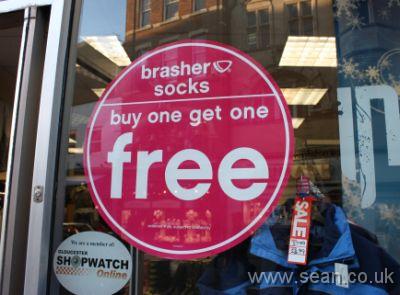
A shop photographed in Gloucester this weekend
I don't know what bothers me more - the fact that they felt they had to explain how socks work, or the fact that this "offer" is only subject to availability.
Labels: marketing, photography
University of Death: Now available in ebook
11 February 2009
I've released an ebook edition of my novel 'University of Death'. It costs £5, half the price of the print edition, and is available now at Lulu. There are no shipping costs (obviously), and it is available for download immediately after payment. You can pay using paypal if you don't want to use a credit card.
This move is partly in response to an email from Sven Augustin who says he likes to read ebooks on his hacked PSP on long train journeys because it means there's less stuff to carry around. He uses the Bookr PDF reader.
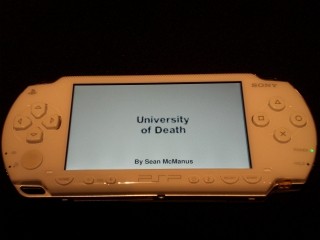
University of Death on a PSP. Photo by Sven Augustin
Clearly, the way that people choose to consume content is changing. Nintendo recently released 100 Classic Book Collection for the Nintendo DS. It includes a library of many books you know you probably ought to read, but it's a shame there's no option to read PDFs of your own choice. Amazon's Kindle ebook reader
  (only available in the US) has made it to a second edition and does offer the ability to read your own PDFs, as well as providing downloadable content. Amazon warns
 that the PDF conversion is experimental, but it nevertheless creates greater opportunities for authors to distribute their content to Kindle readers. I blogged about some of the problems of distributing Kindle content via Amazon previously.
By providing 'University of Death' as an ebook, I hope I'll be able to give people more options for consuming the content as they wish. It also makes it possible for people to access the content more quickly, and to save money on ordering (no postage or print costs). People who wish to can print their own copies to read on paper.
Pricing ebooks is tricky, but at less than the cost of some music magazines, I think £5 represents fair value for the entertainment provided. People tend to think that there are no costs in ebook publishing, but actually the cost of content creation and promotion is the same as it is for printed books. Feel free to leave any comments on the pricing of ebook below.
Labels: books, marketing, technology, university of death
AC/DC excels at web promotion
22 December 2008
AC/DC has released an ASCII art video of "Rock N Roll Train" to promote the band's new album.
The video runs as a macro in an Excel spreadsheet. It has been created using ASCII art stored in cells starting at Q100 and working their way down the sheet (the Q column is hidden), and Visual Basic to show the frames in turn. It's an impressive effect.
Unfortunately, the video is incomplete, presumably so that they don't have to give everyone the song for free (the Excel chart references a WAV file stored externally on your hard drive, which you download with the Excel file).
Even established bands can get lost in the amount of free music online today, so this video is a neat way to stimulate word of mouth and encourage fans to spread the word about the new album.
Labels: marketing, music promotion, software
Cheesy marketing tip
11 November 2008
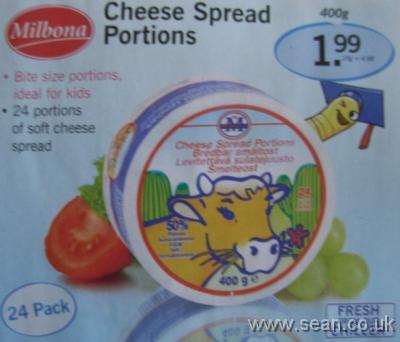
If you want to promote cheese as fresh, and present it with juicy tomatoes and grapes, it might prove counterproductive to adopt a maggot as your mascot. Putting a mortar board on him does not make this a clever move.
Labels: marketing
Virtual book signing tool in this month's Writers' Forum
05 September 2008
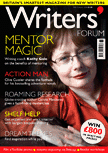 Gosh! It's a good week for book PR. Writers' Forum has published a great story about the tool I've created to enable books to be signed over the internet. It uses a virtually unknown feature of Internet Explorer to send a font of the author's handwriting over the web. The technique enables dedications to be customised with the recipient's name (and potentially, other details too). You can try the tool out by getting your copy of 'University of Death' signed now.
It's great story in the magazine, half a page including my photo and a cover shot. It's nice to be mentioned in the same story as Stephen King and Margaret Atwood, too.
I've offered to help other authors to set up the same facility on their websites. Drop me a line, if you're interested. You'll need to have FTP access to your server, but if you're happy with that, then I can talk you through the steps to get the rest of it working.
Writers' Forum issue 85 is available now from WH Smiths (and probably some other shops too). Nice joke on the front cover about writing for Australian markets, too, with the strapline printed upside down.*
*(It would have been funnier if the article had been laid out upside down, particularly if the unrelated right hand column had been left the right way up. But I guess there has to be a line somewhere.)
Labels: books, marketing, site news, software, university of death, webdesign, writing
Top tips for publishing with Lulu.com
09 July 2008
Based on my experience publishing my novel University of Death through Lulu.com, I've written twelve tips for self publishers on using Lulu.com. I hope they will be useful to people who are considering working with the site, or to those who are in the early stages of planning their publications. If anyone's got any questions about using Lulu, let me know and I'll update that page with responses to those questions.
Labels: books, marketing, publishing, university of death, writing
Great copywriting example
13 June 2008
This is a poster that was in the gents' toilet at a plush hotel where I was a wedding guest recently. I thought it was a great piece of copy, so I took a photo of it.
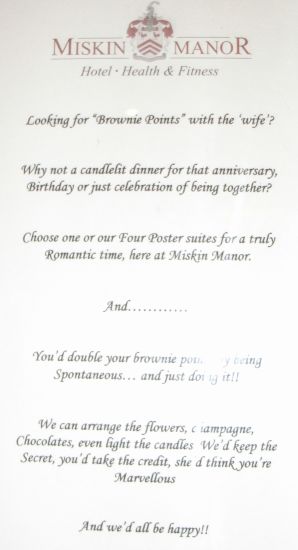
I think what impressed me was the way it addressed its audience directly (men), its economy with words (less than 80), and its subtle call to action (be spontaneous and book now!). The cheeky tone worked well where it was, and the fact it was just printed on hotel stationery made it seem more personal as well. It wouldn't have been nearly as effective if it had been printed on glossy paper by a central marketing division. I should add that this was positioned by the exit, rather than around the urinals where adverts always seem tacky.
Writers beware: read the small print
24 April 2008
There was an advert in Metro last week that read:
We are looking for brilliant new writers to submit entries for our first series of short novels and novellas. Deadline: June 1Adverts seeking 'new writers' are not uncommon - they are typically placed by organisations that sell a publishing service and charge authors to put their books into print. There's not usually any marketing of the title because the company makes its money off printing books and selling them to authors in bulk, and not off selling them to the general public.
The website behind this ad is Roastbooks. From the limited details online, the company's model is to market books through unconventional outlets (eg cafes, airport lounges). White Ladder Press is among the companies pioneering this approach (see The White Ladder Diaries, an entertaining and informative book about setting up a self-publishing operation, which rather unfortunately stops before the operation generates any profit).
I know many people are desperate to get into print, but Roastbooks' terms and conditions are hopelessly optimistic. There's no mention of any advance or royalty rates, but by entering the competition, authors are expected to grant the publisher 'the sole, exclusive option, until two months after the publication of the results of this competition, to enter into a publishing agreement in respect of the submitted manuscript'. I'm not a lawyer, but the language appears to suggest the option belongs to Roastbooks and authors submitting work are basically stuck with the contract the publisher chooses to foist upon them. There's no clause for the rights to revert to the author if the competition results are never announced, or are announced late, either. Roastbooks makes no commitment to a print run, or to any other media, but does require all rights worldwide.
We've seen publishers engaging in rights grabs over the last ten years, but usually from a position of strength. For a new publisher to expect authors to hand over exclusive rights for no return (not even the promise to publish the novel) is highly irregular. The publisher is candid enough to admit that it won't be able to get books into high street book shops, and it's a lot easier for authors to self-publish than it used to be. It's not clear what Roastbooks is doing for the author that the author could not more profitably do for him- or herself.
Few good writers will want to work with an untested publisher that doesn't appear to respect their rights. For that reason, I can't see a future for the company. New publishers would do well to see authors as potential business partners rather than raw materials.
Labels: marketing, publishing, writing
Amazon Kindle: an opportunity for self-publishers?
15 April 2008
I blogged about Amazon's Kindle, a new ebook reader, when it launched. But I didn't look at the opportunity for self-publishers then.
I've published a few ebooks in the past. My ebook 'Journalism Careers - Your questions answered' is sold as a PDF file designed for comfortable on-screen reading. I previously published a guide to putting sound in webpages and a Javascript tutorial through Fatbrain, which was an online ebook store. That folded years ago, and it looks like Barnes & Noble has bought the domain name.
So what's the opportunity at Kindle? Not much for me, it seems. You need to have a US postal address and US bank account details before they will let you publish any content. You can't even publish content for free and use Kindle as a promotional outlet (ebooks must be priced between $0.99 and $200, and you still need to be in the US). Given how slow Amazon's been in internationalising other features like Amazon Honor System, none of that is likely to change any time soon.
My friend John went through the motions of setting up a publication anyway, and has blogged about that experience.
There are a couple of terms that might worry some self-publishers. Firstly:
3. Digital Books; Marketing and Promotion. You agree that we may market and promote your Digital Books by making chapters or portions of your Titles available to prospective customers without charge, and permitting prospective customers to see excerpts of the Digital Book in response to search queries. Amazon will not owe you any fees for the marketing and promotional efforts described above. The Program may include features that allow users to print one or more pages of your Titles.The short version of that is: Amazon can distribute content from the book and allow users to print it, without charging for it and without paying you for it.
The 'permission to print' seems to go beyond the deal Amazon's already struck for 'Search inside this book' for promoting printed books on its website. It's essential for authors to give away some preview content to demonstrate the value of their books. Indeed, similar terms are usually a part of a conventional publishing contract. But Amazon's a shop, not a publisher. Authors and publishers should decide what material is promotional, and what material is only available for sale. Amazon wants the right to give away whatever content it wants, albeit with the implied motive that it will try to pick content that will help the book sell.
For reference works, the value could be significantly eroded if Amazon allows excerpts to be printed without any payment. We can only hope that Amazon is working on a way of administering micropayments so that people can buy book excerpts and authors can be rewarded appropriately.
Also, Amazon will keep 65% of the retail price. By comparison, Lulu charges a fee of 25% of what you get (which is then added to the sale price, so it's actually less than 25% of the ebook price). If you're a self-publisher, 35% is probably not too bad a return given that there's no work to do with moving printed books and there's no cost to incur in creating them, but it's far from competitive. It also seems to overstate the costs incurred in operating the infrastructure and underestimate the costs involved in creating content.
10. Technology. You acknowledge that we will be entitled to utilize DRM technology in connection with the distribution of Digital Books but are not obligated to do so. Accordingly, there may be no technology or other limitation imposed by us on copying or transfer of any Digital Book we distribute.Personally, I don't approve of digital rights management technology. But when publishers are selling ebooks, they'll want to know what rights they're licensing and what controls will be used to enforce them and this term seems somewhat vague. There 'might or might not be DRM' isn't really a good basis for making a decision about whether you want to sell through Amazon, particularly if piracy or consumer rights is something you feel strongly about.
The use of the words 'irrevocable licence' set off alarm bells, but it seems this is about protecting consumers and ensuring that they will be able to download content they've bought easily in future. The irrevocable licence does not extend to making the ebook available for sale (so you can withdraw it later).
If anyone's actually self-publishing through Amazon Kindle, I'd be interested in hearing about your results in the comments.
Labels: journalism, marketing, publishing, technology, writing
Book promotion: Do Private Eye adverts work?
29 March 2008
I'm a keen reader of and subscriber to Private Eye. Given that my novel 'University of Death' has a subplot involving politics and uses a lot of humour in telling its story about the music business, the Eye's 798,000 readers could be an ideal advertising target. Adverts start at £26 for 10 words, which is within the reach of self-publishers.
And indeed, many self-publishers do promote their works there. But I had my suspicions the ads don't work. There's relatively high turnover of advertisers in the Eye Read section compared to some other sections (eg speechwriting), which suggests advertisers aren't seeing results. Additionally, the margin on book sales is such that I'd need to sell more than 13 copies directly attributable to Private Eye to break even. You only need to sell one speech per advert to make your money back, maybe even less if you're booking a series of ads.
I did a spot of market research and emailed five authors who have recently promoted their books in Private Eye and who had a website address. Four were kind enough to reply in some detail, and there was a clear consensus.
Lazz Hewings is a cartoonist researching a book about British Pub culture. He advertised to ask for responses to his questionnaire. He told me:
I was very disappointed with the response, considering the publication has a circulation of close to a million - I had 4 replies! Yes that's right - four! This, I thought, was interesting in its own right.Chris Snowden has written a book documenting the war against smoking and liberty. He said:
I actually got very little response from that advert although I have used Private Eye for business ads before and found them to be quite good. What the response would be for your novel I really couldn't say.Kevin Duffy, author of the novel 'Anthills and Stars' and small press manager, placed a couple of adverts for different books in the same issue. He said:
To be honest, for £120 the response wasn't that great, but that could be my ad, they went to the website and thought what was on offer was a pile of shite...however, glad I did it, I have had some great responses, e mail converstaions etc, but if you're thinking was it cost effective the answer is no it wasn't.Ian Poole used Private Eye to promote his 'radical interpretation of the events in Jesus's life'. He told me:
In answer to your query about the efficacy of Private Eye adverts, I can report that, sadly, it was a waste of £52. As far as I can make out not a single copy sold because of it. Obviously they tend to circulate for a while so it may produce a few, but it certainly has not been a success. Worth a try I suppose. The book has rather narrow appeal, so I think that it may have been the wrong place.I was particularly interested to see that Chris Snowden had found the business ads effective and Kevin Duffy's statement that it had generated some interesting correspondence. That suggests people do read the adverts, so for the right kind of book and right ad copy, there might be an opportunity there to pick up sales. But the experience of recent advertisers should be taken as a warning to authors and publishers that 798,000 circulated adverts does not necessarily translate into even a handful of sales.
Labels: marketing, publishing, university of death, writing
A fresh breath of Oxygene
03 February 2008
I meant to write this before Christmas, but didn't get around to it. Now I have...
The red and white lights of cars travelling on the Champs-Elysees combined with the blue Christmas lights in the trees to make a twinkling French flag. My schoolboy French and a swift internet browser had got me ticket number 94 to see Jean-Michel Jarre performing Oxygene in Paris. As I approached the theatre, near Place de la Concorde where Jarre entertained a million in 1979, there were spotlights reaching up from the theatre's pillars, reminiscent of the lights used at Docklands.
I collected my ticket. As the man on the desk whistled Oxygene IV to himself, I studied the cardboard model of the auditorium. I was in row four. Not bad. Not bad at all. The theatre sat 1000 and was a surprisingly intimate venue for a musician more noted for using skyscrapers as projection screens.
The 45 minute ambient piece 'Waiting for Cousteau' was played in the foyer and theatre before the show. There were a few familiar faces from the Teo & Tea showcase in the audience, which I attended in March.
When the curtain went up, there was an egg shaped chair on the stage which spun around to show JMJ sat on it. It was a nice entrance, but there was no reaction from the audience until he spoke. The weird thing about theatre gigs is that people treat them like plays, and only clap at the end of the acts or when prompted. He delivered a spoken introduction (in French, but with a short English greeting to foreign visitors), brought on the band, and then set up at one of the banks of synthesisers.
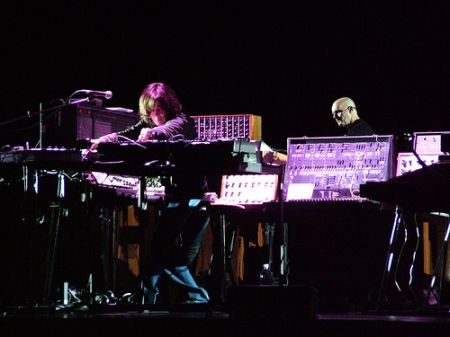
Photo of Jean-Michel Jarre at Theatre Marigny in Paris. © Duncan Walls. Used with permission
There's always been an element of, shall we say... 'computer assisted performance' about a JMJ gig. Quite a few fans maintain that the Teo & Tea showcase was mimed, although it felt pretty real to me at the time. The full spectacle of the typical Jarre concert could only be achieved using some kind of computer synchronisation, but I choose to believe the music is mostly live, most of the time. With your favourite bands, as with religion, faith is everything.
For this show, there would be no fancy slideshows or lasers to hide behind: just a lot of analogue instruments and four musicians. It's trendy for bands to play albums from start to finish at the moment, but that robs the set of most surprises. For Oxygene, one of the first albums I owned, it was good to hear the spontaneity in this performance. Three new variations were included too, which were previously only released on DVD, and the whole set was concluded with one of the tracks from the 1997 sequel album to Oxygene.
At one point, a mirror was lowered over the stage so that everybody could see what was being played. It was odd to see the bass notes on the right hand side of the keyboards, but it reinforced the feeling that this was real. During the show, Jean-Michel played a theramin, some kind of weird stick instrument and a number of other instruments and synths. When he played, he concentrated hard. There was the feeling that this was a show where he was taking real risks and things could go wrong.
The crowd cheered for Oxygene IV, which was an odd reaction. I would have thought any real fan would be mostly tired of it by now (as I am), and would prefer the more mellow Oxygene II and Oxygene VI. But the hit single did sound fresh and the bassline was hypnotic.

Photo of Jean-Michel Jarre at Theatre Marigny in Paris. © Duncan Walls. Used with permission
Last year, Jarre released a re-recording of Oxygene, including a DVD edition that filmed the performance in 3D and provided red and green glasses for watching it. The 3D effects were fun but gave me a headache after a while. The film (also available in a flat version on the 3D disc and separately) is a fine memento of the show I saw. Alongside the DVD edition, a single CD edition of the re-recording was released.
JMJ's now announced that he's going to tour this production worldwide, with gigs announced in the UK, Denmark and Belgium. To promote this, he released the Oxygene re-recording for free with the Mail on Sunday the other week. It's an approach that Prince tried with his new studio album, but it seems JMJ's trying to have his cake and eat it. This isn't previously unavailable material, as Prince's album was: it's a CD that was released for sale just eight weeks ago. Those who bought the album in December are going to be a bit miffed to find it's available for free now. There might well be shops carrying stock that is now virtually worthless too, given that you can buy the CD on Ebay cheaper than you could have bought the newspaper. (The DVD content is still exclusively available through retail).
Newspapers have a unique channel for distributing millions of copies of an album. I'm pleased that some of my favourite acts can reach new audiences this way, but isn't it time for newspapers to start being a bit more creative? The day that an up-and-coming band releases its album for free through a newspaper, and the newspaper has the vision to recognise the opportunity there, will be a scary day for the music industry. Until then, giveaways are basically publicity stunts and artists should be careful whose hand they bite.
Thanks to Duncan Walls for permission to use these photos. See more at Duncan's flickr stream and visit his site JarreUK for the latest tour news.
More from Jean-Michel Jarre
Labels: marketing, music, music promotion
When marketers get lazy
17 November 2007
Two marketing execs, in horn-rimmed glasses, sit around a glass table. "Okay, so cooking oil. What can we do for this campaign?"
"How about... There's a puddle of cooking oil, and it starts to coalesce, like in Terminator, and becomes a Morph-like character, who dives into a chip pan and starts to dance with the chips! We play salsa music, and then display the name of the brand."
"I like your thinking! But what's the budget?"
"Well, we'd need about two weeks of rendering, and probably a month of time from a lead animator. That won't be cheap. And there's the broadcast time too, of course. But the campaign extends smoothly across all media."
"Hardly cheap as chips, though."
The man sighed. It was nearly home time. "I guess we could do what we always do, then."
"What's that?"
"Get a woman in a bra."
"Yes! Our market research suggests that our customer base is largely female, so they're bound to relate to that. What about a tag line?"
"How about 'Sizzling!'. Or 'Hot stuff!'. No, wait. Let's just put 'Cooking!'. Get back to the basics of the message we want to communicate here."
"Like it! And she's writhing in the cooking oil?"
"No, she's a stock photo. She's never been anywhere near it."
"But she looks like she might writhe in the cooking oil?"
"No, she looks like she's been heavily sedated."
"Hmmmm. Not sure I'm feeling it, yet..."
"She does have absurdly large breasts, Sir, and a rather small bra to keep them in."
"Sold!"
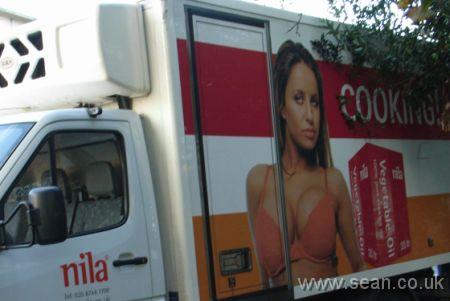
As seen in Chiswick about twice a week. Excuse the poor photo, but some bloke was unloading drums of oil from the back of it, so I had to be discreet. For the avoidance of any doubt, this photograph was taken in 2007, and not 1977 as you might otherwise assume.
Dip into the blog archive
June 2005 | July 2005 | August 2005 | September 2005 | October 2005 | November 2005 | December 2005 | January 2006 | February 2006 | March 2006 | April 2006 | May 2006 | June 2006 | July 2006 | August 2006 | September 2006 | October 2006 | November 2006 | December 2006 | January 2007 | February 2007 | March 2007 | April 2007 | May 2007 | June 2007 | July 2007 | August 2007 | September 2007 | October 2007 | November 2007 | December 2007 | January 2008 | February 2008 | March 2008 | April 2008 | May 2008 | June 2008 | July 2008 | August 2008 | September 2008 | October 2008 | November 2008 | December 2008 | January 2009 | February 2009 | March 2009 | April 2009 | May 2009 | June 2009 | July 2009 | August 2009 | September 2009 | October 2009 | November 2009 | December 2009 | January 2010 | February 2010 | March 2010 | Top of this page |